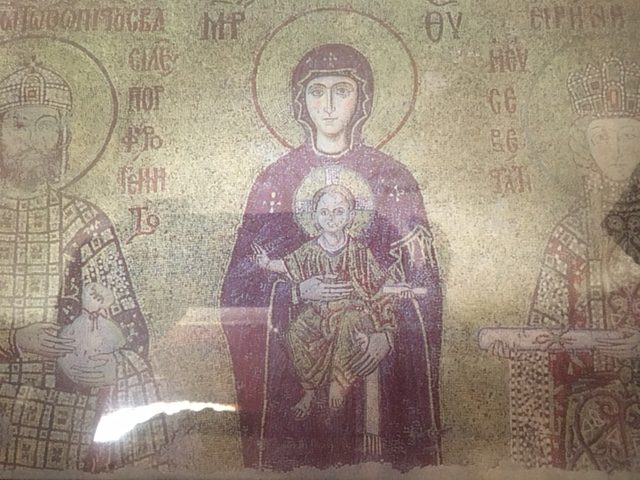
In the latest developments regarding Hagia Sophia. A Turkish professor has called for the removal of mosaics from Hagia Sophia. This is now the second time a Turk has called for the removal of mosaics from Hagia Sophia. The Professor is offended by the image of the Byzantine Empress Zoe who he called a “whore” which is offensive to the conquering Sultan Mehmet II (more on him below).
The first call for the destruction of the Christian mosaics of Hagia Sophia centered around the images of the Serapheim. According to Saint Dyonisios the Areopagite, the Serapheim are the highest ranking angels. The ranking of Angels are the Serapheim, Cherubim, Thrones, Dominions, Virtues, Powers, and Archangels. It is unclear why the Turks were offended by the Serapheim in particular and not by the other iconography. Of course, we are not dealing with rational people.
The Holy Synod of the Bulgarian Orthodox Church took a position criticizing Turkey for the move to convert Hagia Sophia and emphasized the importance of the Church to Orthodoxy. The Bulgarian Church joins the Churches of Russia, Serbia, Rumania, Jerusalem, Georgia, Cyprus, Greece, and Albania in criticizing the Turkish government’s plans for Hagia Sophia. This is in addition to the Vatican and the World Council of Churches.
A commentator in the newspaper, “The Saudi Gazette” has condemned President Erdogan for the conversion of Hagia Sophia. In Egypt, the Grand Mufti has also condemned President Erdogan’s decision and said that Islam prohibits the conversion of Churches. These voices in the Muslim world that are protesting the conversion of Hagia Sophia are very much welcome. On the other hand, Iran has praised President Erdogan for converting Hagia Sophia.
Returning to the Turkish Professor and Sultan Mehmet II. The Professor objects to the depiction of the Empress Zoe for being in his words, “a whore”. Quite ironic considering that the conquering Sultan Mehmet II was not only a heavy drinker (in contrast to Islamic teaching) but a homosexual and a pedophile. According to the great Byzantine historian Steven Runciman, after the conquest of the City the Sultan asked the Grand Duke Lucas Notaras to help him rebuild the city.
Upon meeting the Grand Duke’s two sons the twenty one year old Sultan expressed an interest in the younger boy. The Grand Duke said no and for this refusal both the Duke and his sons were sentenced to death by decapitation. Apparently, the Turks need some reminding of Mehmet’s personnel life, especially as he is the Turkish President’s hero.
It appears that despite assurances that President Erdogan has given the Russians, the mosaics of Hagia Sophia will ultimately be destroyed. Turkish assurances are worthless in any circumstances. The fact that Turkish academics and others are openly demanding the destruction of a particular mosaic indicates they have a Taliban mentality.
Despite what this fake Professor says, Hagia Sophia is not a Mosque. Hagia Sophia is a Church and was established as such in the sixth century. Other than disregarding the theological origins of Hagia Sophia, this pseudo academic disregards the historical and cultural relevance of the iconography of Hagia Sophia.
President Erdogan had the chance to improve his image which has taken a beating because of his government’s collusion with ISIS. If he had been inclined to respond positively to the international appeals to leave Hagia Sophia alone, he could have demonstrated an inclination for moderation and restraint. Instead, he is affirming his image as an extremist.
It appears that only a small fraction of Muslims have reacted positively to Turkish President Erdogan’s plans to convert Hagia Sophia into a Mosque. Not even the statement that Erdogan plans to liberate the Al Aqsa Mosque in Jerusalem has been able to generate much enthusiasm. Sure, a few radicals in Hamas, the Muslim Brotherhood and a few others have praised Erdogan’s plans, but for most of the Muslim world there is complete indifference or outright criticism.
Most surprising is the news that Saudi Arabia has adopted a critical stance toward Erdogan’s intentions for Hagia Sophia. The refusal of the Muslim world to enthusiastically back Turkish plans is very welcome and bodes well for the future of Christian-Muslim relations. Today, in the New York Times there is an op-ed by a Turkish writer opposing the conversion of Hagia Sophia and also calling for the reopening of the Patriarchal School on the island of Halki.
The op-ed can be found on the post for this blog entitled “Hagia Sophia New Sources”. This can be found by looking up New York Times in the search engine and clicking on the first link. Under the various links, the first full article is today’s op-ed in the New York Times.
Today, President Erdogan of Turkey made a tour of Hagia Sophia. Last week, Hagia Sophia was transferred from the Ministry of Culture to the Ministry of Religion. Its doors were closed to the public and the process of transforming the Great Church began.
One thing that Greek Orthodox Christians can take pride in is our reaction. We responded with protests and by contacting governments, institutions, and elected officials. We did not riot, we did not kill anyone, or engage in any sort of violence despite the blasphemous actions undertaken by the Turkish Government. We behaved like Christians.
Assuming that nothing changes from now until Friday and Hagia Sophia serves as a Mosque. Turkey will have won the battle, but not the war. Turkey will have lost the last remnants of a reputation that was carefully built up by Mustafa Kemal and his successors throughout the twentieth century. Turkey can never again claim to be a secular state.
The modern Turkish State was built on genocide. Kemal built the Turkish Republic over the corpses of Armenian, Assyrian, and Greek Christians. The Turks have forgotten that their victories were achieved through the active support of Great Britain, Italy, and France who armed Kemal’s armies in Anatolia while an embargo was imposed on the Greek Army at the time.
Throughout the twentieth century the Turks were quite successful at public relations. They built a false image of a Muslim country that was secular and democratic. Few people other than some diehard Turkophiles in America and Europe took seriously the notion that Turkey was a democracy. Everyone (including Turkey’s critics) believed that Turkey was a secular country.
Was Turkey ever really a secular country? Outwardly, Turkey was a secular country because religion was separate from the state. Men and women dressed and looked like westerners. Under the surface however Islamism never really went away. For example, during the second world war, the “ghiavhors” (infidels) including Greeks, Armenians, and Jews were the recipients of a heavy tax that the government knew they could not pay. Those unable to pay were shipped off to concentration camps in Anatolia from which most never returned.
Before the outbreak of the anti Greek pogroms of 1955 (which also targeted Armenians and Jews) Christian homes were labelled with crosses so the population would know their targets. The pogroms were primarily anti-Christian a fact that proves that secularism never penetrated the soul of the Turkish nation. During the 1950’s Prime Minister Adnan Menderes flirted with the Islamic establishment and as a result of his Islamic sympathies and authoritarian nature was executed following the Turkish Coup of 1960.
The Turkish invasion of Cyprus in 1974 likewise demonstrated that Islam still had a hold on Turkish society. The conversion of Greek and Armenian Churches in occupied Cyprus into Mosques is proof that secularism in Turkey existed only at the official level. The conversion of Hagia Sophia may be the demise of the final vestige of secularism that existed in Turkey.
President Erdogan has brought negative attention on Turkey. This attention is on top of the negative attention that Turkey received because of Ankara’s tolerance of/and support for the Islamic State. The conversion of Hagia Sophia may come to haunt the new Turkish Sultan.
The Russian government has declared the matter of Hagia Sophia to be an internal matter for Turkey. The Russian government did take up the matter with Turkey and President Erdogan has apparently assured the Russians that the Christian-Byzantine iconography will be protected. The Russians did protest and members of the Russian Duma had sent protests to their counterparts in the Turkish Parliament. The Russian Church likewise publicly protested.
Two Bishops of the canonical Ukrainian Orthodox Church have taken positions on Hagia Sophia. One Bishop denied that the conversion of Hagia Sophia was God’s punishment on the Ecumenical Patriarchate and stated that Hagia Sophia did not belong to the Patriarchate or to Turkey, but only to God. Another Bishop declared that the day may yet come when Hagia Sophia becomes a Church, and also went on to point out (correctly) that Hagia Sophia has been an issue for years but that Patriarch Bartholomew chose instead to intervene in the Ukrainian Church.
The Greek world must now decide how to proceed. The best idea has been suggested by some Greeks who believe that Kemal’s house in Thesaloniki should be seized from the Turkish Consulate and be turned into a genocide museum. Absolutely a great idea. The Greek Mayor of Thessaloniki in 1937 donated that house to the Turkish Consulate in a spirit of good will (without getting anything in return from Turkey such as Hagia Sophia).
In 1955, the staff at the Turkish Consulate bombed Kemal’s house in order to stir up anti Greek hatred for the pogroms in Constantinople. The Consulate should have been closed then, its staff arrested, and the house turned into a public restroom or a shelter for animals. In 2015, I walked by the Consulate-Museum while visiting Thessaloniki.
The place looks like something out of East Germany. There were security cameras and no one around to answer the door when I decided I would visit the Museum. A very sinister looking place and it is long past time the Consulate was closed and the house done away with. A genocide Museum would be perfect in honor of the Armenian, Greek, and Assyrian Christians slaughtered by Kemal.
It is also time to continue to work for the recognition of the Armenian, Assyrian, and Greek genocides. It is also time to take the gloves off regarding Turkey. While the support for Hagia Sophia has been welcome, most articles have been too deferential to the murderous Turkish regime. Kemal has been referred to as some sort of enlightener of the Turkish nation when he was a butcher.
In recent years, two excellent books have been published. “The Great Fire” by Lou Ureneck and “The Thirty Year Genocide” by Benny Morris and Dror Ze’evi which are masterpieces. The genocide of the Greeks is gradually gaining recognition. Working to gain full recognition of the genocide and working for justice for Cyprus and the defense of the Greek islands are the best ways to respond to the seizure of Hagia Sophia.
“O Lord save your people and bless your inheritance! Give victory to those who battle evil, and with your cross protect us all!
The Holy Synod of the Russian Orthodox Church held its meeting and once again expressed its opposition to the change of status of Hagia Sophia. They agreed on a statement made in recent days by Metropolitan Serapheim of Piraeus of the Church of Greece that the Ukraine schism made it difficult for the Orthodox world to unite against a common threat. In other developments in recent days, the Islamic Society of America came out in opposition to Turkish plans to convert Hagia Sophia. A very welcome gesture indeed!
The Arab News newspaper published two articles criticizing Turkey’s conversion of Hagia Sophia into a Mosque. In addition, NBC News has interviewed dissidents in Turkey who see the conversion of Hagia Sophia as an ominous sign of things to come. President Erdogan has become repressive in recent years and this attack on Hagia Sophia has been widely condemned by many Turkish intellectuals including Nobel Prize Winner Orhan Pamuk and novelist Elif Shahak. Likewise historian Taner Ackam a Turkish academic who has published books on the Armenian Genocide has also opposed the move.
In America, the Greek Orthodox Archdiocese has declared July 24 a”day of mourning”. I am not quite sure what that is intended to accomplish but the fact of the matter is that the Greek Archdiocese has been quiet for the last seven years on this matter. The move to make Hagia Sophia a Mosque began in 2013 when the Church-Museum of Hagia Sophia in Trebizond was converted into a Mosque.
Since then, the Turks have converted two other Church-Museums (both named Hagia Sophia) in Nicea (Iznik) and Adrianople (Edirne) into Mosques. I do not recall any protests in response to these conversions. In my opinion, these were test runs by the Erdogan government in Turkey to get a feel for international opinion. Having received virtually no criticism for converting these former Churches, the Turkish President was encouraged to prey upon the Great Cathedral itself.
It is only now at the last minute that the international community weighed in. In recent days, the Church of Greece urged UNESCO to be more assertive on the matter. Like the Greek Archdiocese of America, the Synod of the Church of Greece remained quiet until the last minute. The same can be said for the academic community which remained quiet for many years.
Byzantine historian Judith Herrin (an author of very fine books on Byzantine history) had an op-ed published in the Washington Post. A very welcome criticism of Turkey, but what took so long? It is in fact great to see so much international interest in Hagia Sophia but it should have manifested itself earlier than this.
The Greek world in particular has to think long term at this point. In the event that a miracle does not occur (a possibility that Orthodox Christians never dismiss) the Greeks will have to consider what to do then. The Greek Churches badly need to reconcile with the Orthodox world, and this means resolving the schism in Ukraine.
Greece in turn needs to reflect on the matter of its identity and role. It is good to see Greeks taking an interest in Hagia Sophia. Let this be the occasion for the faithful in Greece to overturn gay marriage and the transgender agenda that the former ruling party of Syriza imposed on Greece. Whatever happens with Hagia Sophia, the Greek world must recapture the moral, theological, and spiritual ethos of the gospel, the apostles, and the fathers of the Church which produced Hagia Sophia.
I have ceased all commentary on anything other than Hagia Sophia. I will be counting the days till the dark day which Turkey has scheduled for July 24.
It was said that the Fall of Constantinople was God’s punishment for the apostasy of the Greeks when they signed the false union of East and Western Christians at the Council of Florence in 1439. Today, there are opinions emanating from a variety of sources suggesting that the impending conversion of Hagia Sophia is God’s punishment for the role of the Ecumenical Patriarchate in fomenting the schism of the Churches in Ukraine. Whether this is true or not is impossible to say. One prominent Bishop within the Church of Greece believes this is the case while some Russian and Ukrainian Bishops deny that this is so.
The Knights of the Fourth Crusade desecrated Hagia Sophia long before the Ottoman Turks. After Constantinople was invaded and occupied by the Crusaders the Churches, palaces, and libraries of Constantinople were sacked. Hagia Sophia was not spared as it was defiled in unspeakable ways by western Christians. Other than robbing the treasures in the Church, the Latins also brought a prostitute into the Great Cathedral who sat on the Patriarch’s throne.
Hagia Sophia is also the subject of myths and legends. One legend has it that during the building of the Great Church in the sixth century, the Archangel Michael came down from heaven and asked a boy where the builders were. The boy responded and said they were eating lunch. The Archangel told the boy to go and call them for this Church needed to be built very quickly.
After the Fall of Constantinople, a legend was told about the mysterious priest in Hagia Sophia. It was said that he disappeared inside the Church so that the Turks would not defile the holy gifts. According to the legend, when Hagia Sophia becomes a Church once more the priest will reemerge to complete the liturgy.
Another story is told during the centuries of the Ottoman Empire. It was said that there was a locked door high up in the Great Church. An Englishman in Constantinople was said to have been hired by the Turks to open the door. Somewhat frightened by what might be behind the door, the Englishman advised the Sultan to leave the door alone. The Sultan is said to have complied with this advice.
In 2016, the Turkish government permitted an Islamic cleric to read Koranic prayers in Hagia Sophia. During that summer, an attempted Coup against the Turkish President ensued. The disturbance of Hagia Sophia was put to rest…………….until now!
“We want-oh mother -we want no mosques, no hodjas to call out, (oh, sweet mother, our lady aid us) We only want St. Sophia, the great Monastery”
From a Greek Song “We want no mosques here”
The Most Holy Theotokos (Mother of God) came to be viewed as the protector of Constantinople after the successful defeat by the Empire of the Avars after 626 AD. Enemy combatants described seeing a woman over the walls of the City during the fighting near the blachernae section of the city. There was a Church (and still is) dedicated to the Theotokos at that part of the city. An all night vigil was held in that Church asking for her intervention to save the City. The Icon of the Holy Wisdom (Hagia Sophia) of God. The Great Church of Constantinople is named for the wisdom of Christ Hagia Sophia in use as a Mosque during the Ottoman Empire. This image is French and dates to 1719.
Greek political poster from the Balkan Wars of 1912 to 1913. Prime Minister Eleutherios Venizelos led Greece to victory and presided over the liberation of Macedonia, Crete, and Epirus. I believe the woman he is picking up symbolizes Greece. The Angel on top is bringing in the new year of 1913. Note on the left the image of the Parthenon at Athens. On the right the double headed eagle over the image of Hagia Sophia. Greece was supposed to liberate the city.
Venizelos and his Ministers and Generals and Bishops of the Church in front of Hagia Sophia. In 1920 Herbert Adam Gibbons who reported on the campaign in Asia Minor and later sent news dispatches to the Christian Science Monitor documenting the genocide of the Greeks and Armenians published a biography of Venizelos. The last paragraph of the book.
“In the prayer of eight million Greeks, “Zeto Venizelos!” the aspirations of Hellenism are practically expressed. For if the Cretan lives, and continues to lead, he will accomplish what the greatest Meditteranean islander before him failed to accomplish. He will take possession of Constantinople.”
Venizelos lost the elections of December 1920 and Greece’s fortunes in Asia Minor collapsed. The Great Church awaits to become a Church once again…..someday
In 1453 the Orthodox Greeks in Constantinople were hoping that a miracle might prevent the fall of the City. It was not to be. Today we await again and place our hope in the Theotokos. I believe in miracles.
From another old Greek song on the Fall of Constantinople,
“Today the Churches chant, and all the monasteries, and Saint Sophia chants, the great monastery, A high voice came from the heavens, Saint Sophia is taken by the hand of infidels. Let the chanting stop and lower the sacred vessels, The Turks have taken the City”.
Considering the international attention on Hagia Sophia and my recent review of Elia Kazan’s masterpiece “America America” I have concluded the time is right for a review of a great Greek film. This film, “A Touch of Spice” was made in Greece and Turkey and was shown in the United States in 2005. The film is about a Greek family in Constantinople that were impacted by the expulsions of 1964.
The film tells the story of a boy and his parents who are forced to leave Constantinople by the Turkish authorities. At the time many Greeks with Hellenic citizenship were expelled from Turkey, and since they were married to Greeks native to Constantinople thousands of families were forced to leave their homes and their beloved city. Human Rights Watch in its 1992 publication “Denying Human Rights and ethnic identity the Greeks of Turkey” stated that 30,000 Greeks left Turkey after the initial deportations.
The film has wonderful Greek and Turkish actors and is filmed on location in Greece and Turkey. And yes there is a wonderful scene that includes Hagia Sophia. In addition, there is a great scene in which the boy lights a candle in a Greek Church in Constantinople.
It is a very sentimental and nostalgic film with elements of comedy. I will refrain from ruining the plot and simply recommend this film to be added to anyone’s Greek film collection with “America America”.
Here is a list I am compiling of films that include the city of Constantinople and/or Hagia Sophia. I will probably be adding to the list.
Council of Europe Condemns Hagia Sophia Conversion From Museum to Mosque
Αssociated Press
(AP Photo/Emrah Gurel)12/5/2020 Athens News Agency
BRUSSELS – The Parliamentary Assembly of the Council of Europe (PACE) on Friday condemned Turkey’s July 13 unilateral decision to change the status of the UNESCO-protected World Heritage Site of Hagia Sophia in Istanbul from a museum to a mosque.
PACE’s Committee on Culture, Science, Education & Media also adopted a written declaration, which says the decision is “a discriminatory step backwards, that clearly undermines Turkey’s secular identity and multicultural legacy.”
The Committee stresses that it “also runs counter to the Parliamentary Assembly’s core values and principles, particularly as regards interreligious and intercultural dialogue and the principle of living together.
Chairperson of the Greek Parliamentary Delegation to PACE Dora Bakoyannis, wrote on Twitter: “Europe takes a stand against Turkey’s systematic policy of violating democratic principles and values.”https://disqusservice.com/iframe/fallback/?position=top&shortname=ekirikas&position=top&anchorColor=%230000ee&colorScheme=light&sourceUrl=https%3A%2F%2Fwww.thenationalherald.com%2Fcommunity_church_world%2Farthro%2Fcouncil_of_europe_condemns_hagia_sophia_conversion_from_museum_to_mosque-1347241%2F&typeface=serif&canonicalUrl=https%3A%2F%2Fwww.thenationalherald.com%2Fcommunity_church_world%2Farthro%2Fcouncil_of_europe_condemns_hagia_sophia_conversion_from_museum_to_mosque-1347241%2F&disqus_version=363c4ce
How a Historian Stuffed Hagia Sophia’s Sound Into a Studio
Bissera Pentcheva used virtual acoustics to bring Istanbul to California and reconstruct the sonic world of Byzantine cathedral music.
Hagia Sophia’s rededication as a Muslim place of worship, after decades as a museum, threatens to cloak its extravagantly reverberant acoustics.Credit…Piotr Redlinski for The New York Times
By Corinna da Fonseca-Wollheim
July 30,2020
Turquoise carpets covered the marble floor, with its geometric designs. White drapes concealed the mosaic of the Virgin and Christ. Scaffolding obscured crosses and other Christian symbols.
Footage broadcast around the world last week captured some of these striking changes to Hagia Sophia, the Byzantine cathedral in Istanbul, which served as a mosque under Ottoman rule before becoming a museum in 1934. On the orders of Turkey’s president, Recep Tayyip Erdogan, it is now once again used as a mosque.
But for a group of scholars, scientists and musicians, Hagia Sophia’s rededication as a Muslim place of worship threatens to cloak a less tangible treasure: its sound. Bissera Pentcheva, an art historian at Stanford University and an expert in the burgeoning field of acoustic archaeology, has spent the past decade studying the building’s extravagantly reverberant acoustics to reconstructthe sonic world of Byzantine cathedral music. Ms. Pentcheva argues that Hagia Sophia’s mystical brilliance reveals itself fully only if it is viewed as a vessel for animated light — and sound.
The building was reopened for worship for the first time in 86 years last week.Credit…Nevzat Yildirim/Anadolu Agency, via Getty Images
“The void is a stage,” she said in a recent interview over Zoom.
Conducting research inside this contested monument has required a mixture of diplomacy, ingenuity and technology. Turkish authorities forbade singing inside Hagia Sophia, even when it was operated as a museum. Now that the building falls under the jurisdiction of religious authorities, that ban will harden, and further research may be even more difficult.
But Ms. Pentcheva’s existing work culminated last fall in the release of “The Lost Voices of Hagia Sophia,” an album that brings to life the stately mystery of Byzantine cathedral liturgy, bathed in the glittering acoustics of the space for which it was written — even though it was recorded in a studio in California.
For about 20 years, it has been possible to superimpose the acoustics of a particular space onto recorded music during postproduction. A pioneer was Altiverb, a plug-in software that draws on a large library of virtual spaces so that a recorded track can be retrofitted to seem like it was done in, for example, the Berlin Philharmonie or the King’s Chamber inside the Great Pyramid of Giza.
But in what has become known as live virtual acoustics, processors and speakers provide the acoustic feedback of a particular space in real time, so that musicians can adjust their performance as if they were really in another building.
Jonathan Abel, a consulting professor at the Center for Computer Research in Music and Acoustics at Stanford, devised a plan with Ms. Bissera that allowed her to capture vital information about the acoustic properties of Hagia Sophia with the help of a balloon, discreet recording equipment and a cooperative security guard.
In the winter of 2010, Ms. Pentcheva obtained permission to enter what was then a museum at dawn, when Istanbul was quiet. She persuaded a guard to stand in a spot that would have been occupied by singers during the Byzantine era and to pop a balloon. In the meantime, she stationed herself where a privileged member of the public might have experienced mass. Microphones captured the explosion of sound and the ensuing wash of reverberations.
Ms. Pentcheva was allowed to capture only four such pops over two visits. But those bursts of sound yielded a wealth of data.
One of the balloon pops in 2010 that helped Bissera Pentcheva capture the acoustics of Hagia Sophia.Credit…Bissera V. Pentcheva
“That little balloon pop brings back all the information about the material and the size of the space,” Mr. Abel said. “You can think of a human voice as being made up of a whole bunch of balloon pops. Each voice drags behind it a bunch of impulse responses, like streamers behind a wedding car.”
The balloon noises, along with maps of the interior, allowed Mr. Abel to identify what he called the acoustic fingerprint of the building, including the multidirectional refraction of sound as it bounces off the dome and marble colonnades. His computer simulation was then integrated into a set of microphones and speakers.
Thus the members of Cappella Romana, a vocal ensemble based in Portland, Ore., specializing in Byzantine chant, recorded “The Lost Voices” in a space that persuasively mimicked the acoustics of Hagia Sophia — with its luscious reverberation, cross echoes and amplification of particular frequencies.
Alexander Lingas, a musicologist and the music director of Cappella Romana, said that the live virtual acoustics were transformative to his understanding of the group’s repertory. The long reverberation time dictated slower tempos. Basses singing drones made subtle pitch adjustments to match frequencies of maximum resonance.
Mr. Lingas said that some pieces only “made sense” inside the simulated acoustics. One example featured on the album is a cherubic hymn that likens the singers to angels.
“The music is designed to convey that,” Mr. Lingas said. “But I remember editing this piece and thinking, ‘My, this is really strange.’” Yet, he added, as the group rehearsed it with the virtual acoustics, a pattern of repeated undulating motifs built up rippling momentum until, as he described it, “the sound essentially achieved liftoff.”
Ms. Pentcheva believed that in Byzantine cathedral chant, reverberation was key to invoking the divine presence. She pointed to the exuberant amount of melisma in the repertory, where a single syllable is stretched over multiple notes. In the liquid acoustics of Hagia Sophia, words sung in this way blur, the way a line drawn in ink bleeds on wet paper.
“Rather than containing this smearing of semantics, the music itself actually intensifies it,” Ms. Pentcheva said. “So there is this process of alienation and estrangement from the register of human language that happens in Hagia Sophia, and is a desired goal.”
In Greek Orthodox rites, Ms. Pentcheva argued, acoustics and chant interact in a way that “is not about sound carrying information, but sound precipitating experience. It is a fully corporeal investment.”
The recording provides a glimpse of that experience. Phrases chanted in unison leave a ghostly imprint. Rhythmic shudders and grace notes set off blurry squiggles of overlapping echoes. Chords unfurl in reverberant bloom.
The acoustic drama of Hagia Sophia would have unfolded alongside the changing light and curling smoke of burning incense, enveloping the senses. The effect is described in a 6th-century description of the building by Paul the Silentiary, an aristocrat and poet at the court of Justinian.
“He speaks about a human action that brings into presence the divine reaction, the divine voice,” Ms. Pentcheva said. “In a sense that is the reverberation of the space: After the human voice stops singing, the building continues.”
Patriarch Kyrill, head of the Russian Orthodox Church issued a public statement that was highly critical of the Turkish Government’s plans to convert Hagia Sophia into a Mosque. In addition, a group of scholars from around the world have signed a petition calling on the Turkish government to maintain the status quo in Hagia Sophia. This is on top of Secretary of State Mike Pompeo’s letter to President Erdogan of Turkey asking him to maintain the status quo of Hagia Sophia last week.
I have to say this is more like it. For too long there has been a silence in response to Turkish policies, and not just Hagia Sophia. As I have suggested on a previous post Hagia Sophia is going to create problems for Turkey. As I have written before, Hagia Sophia is hallowed ground. Violating that hallowed ground is creating serious problems for the Turkish government.
The wording in the petition was rather disappointing. There was too much emphasis on the Ottoman background of Hagia Sophia and not enough on the Byzantine-Greek Orthodox background. Still, it is a petition that is proving helpful in the opposition to the Turkish government’s plans for Hagia Sophia.
If President Erdogan remains committed to converting Justinian’s Church, he will be bringing much attention not only on Hagia Sophia, but on Turkey in general. He will be bringing more attention to the authoritarian nature of his regime. He will also be causing the further deterioration of Turkey’s image throughout the world.
Furthermore, Turkish-Russian relations may suffer should Erdogan persist in altering the status of the Great Church. It should be remembered that Turkish-Russian relations were good until Erdogan ordered the downing of a Russian plane over Syria. That nearly destroyed relations with Russia. Furthermore, the assassination of the Russian Ambassador in Ankara demonstrated the fervent anti Russian sentiment in Turkey because of Russian-Turkish differences in Syria.
Erdogan offered apologies to Russia over the downing of the Russian plane in order to repair relations with Moscow. It is uncertain what will happen if Turkish-Russian relations are diminished once again.
In any case, here are the relevant links. The Russian Patriarch’s statement is very strong.